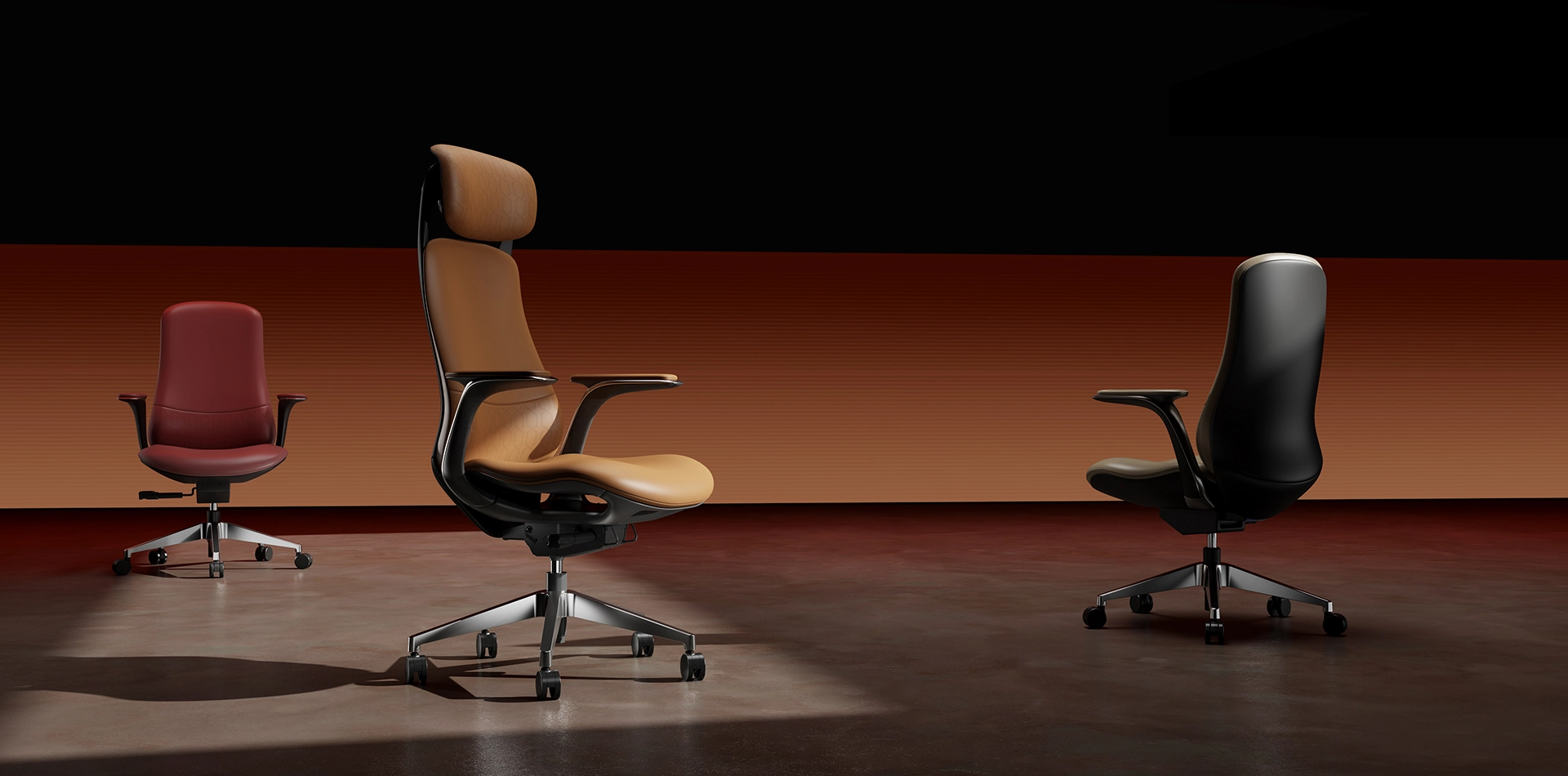
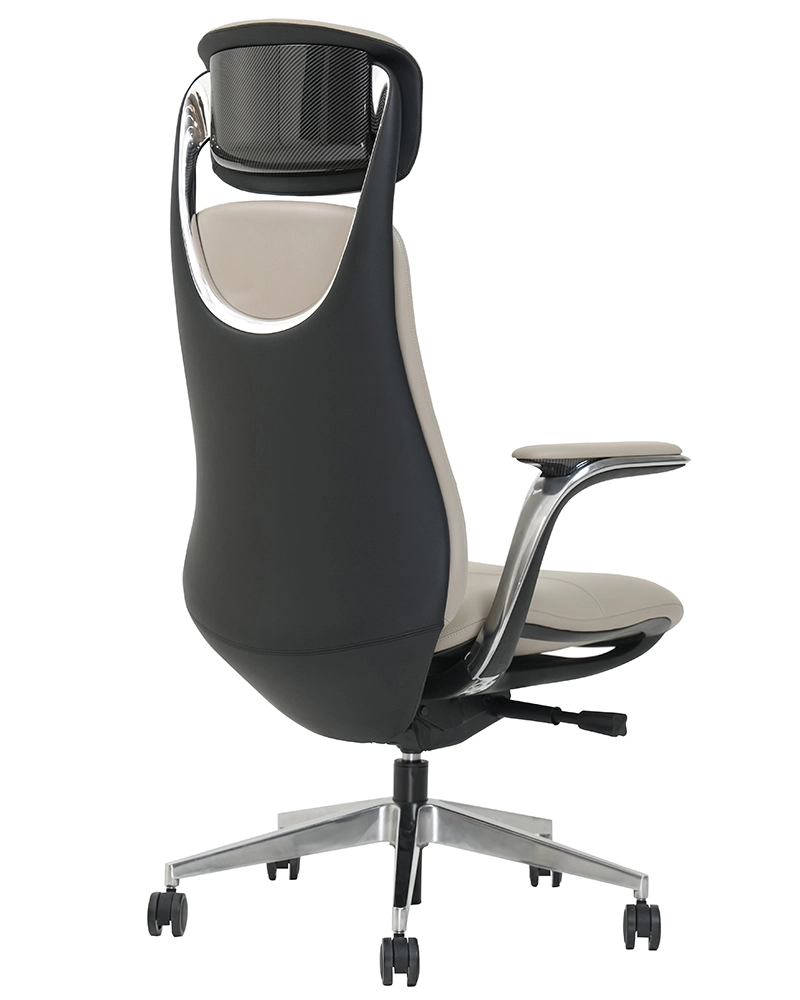
The difference between an ordinary desk chair and a genuine executive leather chair shows up hours into the workday, not in the first five minutes of sitting down. Top-grain leather — the layer just beneath the hide's outermost surface, sanded and refinished for a consistent grain — resists the stretching and cracking that lower-grade upholstery develops under daily pressure. It holds its shape across the seat and backrest instead of bagging out at the edges, and it responds to body heat rather than staying cold or growing clammy the way many synthetic covers do. On an executive chair, that leather isn't limited to the seat pan: when it wraps the headrest and armrest surfaces as well, every point of contact — head, forearms, thighs — gets the same consistent hand-feel, which is part of why executive-grade seating reads as a single considered product rather than a frame with cushions bolted on.
A chair's real quality lives in the components buyers rarely see listed in full. Below is a breakdown of what each specification on this executive model contributes to comfort, support, and service life.
Seat foam. Molded foam at 65mm thickness, 60kg/m³ density, and 35N hardness sits in the mid-firm range deliberately. Density in the 55–65kg/m³ band is the threshold most contract-furniture buyers look for because it resists compression set — the permanent flattening that cheaper 30–40kg/m³ foams suffer within a year or two of daily use. A hardness rating of 35N keeps the seat supportive enough for correct pelvic alignment without feeling like a park bench, which matters most for anyone logging six-plus hours a day in the chair.
Mechanism. This chair's mechanism combines a 5cm seat slide, 20° recline, pneumatic height adjustment, and a 3-position lock, starting from a 105° initial angle. The 105° starting position is slightly more open than the "neutral" 90–100° most task chairs default to, which puts less pressure on the lumbar spine from the moment you sit down. The 3-position lock lets the user fix the backrest at upright, mid-recline, or full recline rather than fighting a free-floating tilt tension all day, and the 5cm slide adjusts seat depth independently — useful for taller or shorter users who need the front edge of the seat clear of the back of the knee.
Base and casters. A 350mm-radius base in polished aluminum alloy gives the chair a wider, more stable footprint than the 300mm bases common on standard task chairs — appropriate for a taller-backed executive frame with more weight riding higher off the floor. The five-point base pairs with 6cm PU casters (1.8cm shank), which roll quietly and won't mark hard flooring the way harder nylon wheels can.
Gas lift. A Class 3 gas lift (265mm overall length, 10cm stroke, 8cm tail) is the mid-tier safety and durability rating used in most commercial-grade office seating, tested well beyond typical executive-chair load ranges.
Backrest, seat board, and armrest bracket. The backrest frame is PA+GF (glass-fiber-reinforced nylon) — a material chosen for its rigidity-to-weight ratio, holding its shape under the leverage of a full recline without adding bulk. The seat board uses a full plastic seat frame for the same reason: strength without the added weight of a steel or plywood pan. Armrest brackets in aluminum alloy carry the top-grain leather armrest surface, matching the finish of the base for a cohesive look at every visible metal point.
For any buyer comparing executive leather chairs at the spec-sheet level, four features tend to separate genuinely ergonomic seating from chairs that only look the part:
Because the headrest and armrest surfaces on this model both use top-grain leather while the backrest frame is engineered plastic and the base is polished aluminum alloy, the chair is built around a deliberate split: leather where the body makes contact, engineered materials everywhere structural load is carried. That split is also what makes the design practical to customize — leather grade, tone, and stitching can be adjusted for a private-label or wholesale order without altering the mechanism, base, or gas lift ratings underneath. For buyers sourcing at volume, that separation between "touchpoint materials" and "structural materials" is usually the fastest place to start a conversation about OEM/ODM specification changes.
Top-grain leather needs less maintenance than people expect, but it isn't maintenance-free. A weekly wipe with a soft, slightly damp cloth clears dust and oils before they settle into the grain, and a leather conditioner every two to three months keeps the surface from drying out and cracking — particularly on the headrest and armrests, which see the most direct skin contact. Keep the chair out of continuous direct sunlight, which fades and dries leather faster than daily use ever will. Beyond the leather itself, an occasional check of the gas lift and caster wheels for grit build-up keeps the mechanism moving smoothly for the long term the Class 3 rating is designed for.
For detailed cleaning routines, leather-care product comparisons, and humidity control tips, read our Leather Office Chair Care Guide.

0086-0572-5325985
info@novosit-global.com
Leave your email address to receive our latest updates.